

Reed Organic Supply

Liebig's Law Of The Minimum
Are your agriculture practices antiquated?
Liebig's law of the minimum, is a principle developed in agricultural science by Carl Sprengel (1828) and later popularized by Justus von Liebig.
Liebig improved organic analysis with the Kaliapparat-- a five-bulb device that used a potassium hydroxide solution to remove the organic combustion product carbon dioxide. He downplayed the role of humus in plant nutrition and discovered that plants feed on nitrogen compounds and carbon dioxide derived from the air, as well as on minerals in the soil. One of his most recognized and far-reaching accomplishments was the invention of nitrogen-based fertilizer. The technology to study the interrelationships between the soil, microbes and the plants was not available at that time.
Liebig believed that nitrogen must be supplied to plant roots in the form of ammonia. Though a practical and commercial failure, his invention of fertilizer recognized the possibility of substituting chemical fertilizers for natural (animal manure, fish, etc.) ones. He also formulated the Law of the Minimum, stating that a plant's development is limited by the one essential mineral that is in the relatively shortest supply, visualized as "Liebig's barrel". This concept is a qualitative version of the principles still being used to determine the application of fertilizer in modern agriculture. This is a 186 year old technology!
Liebig's Law of the Minimum states that growth is controlled not by the total of resources available, but by the scarcest resource. This concept was originally applied to plant or crop growth, where it was found that increasing the amount of plentiful nutrients did not increase plant growth. Only by increasing the amount of the limiting nutrient (the one most scarce in relation to "need") was the growth of a plant or crop improved.
Liebig's Law has been extended to biological populations. For example, the growth of a biological population may not be limited by the total amount of resources available throughout the year, but by the minimum amount of resources available to that population at the time of year of greatest scarcity. That is, the growth of a population of animals might depend not on how much food is available in summer, but on how much food is available in winter.

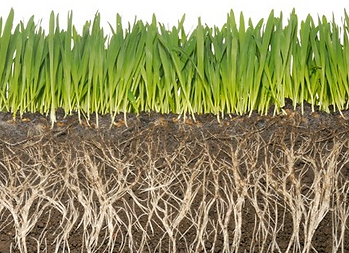
I find it amazing the so many farmer's today still use these antiquated practices on their farms. The study of soil microbes has created a new technology based more on the principles of nature and less on inputs of chemicals. That all living organisms have a symbiotic relationship, the air, water, soil, microbes, worms, and the plant all working in an unseen harmony. Nitrogen is taken form the atmosphere by microbes in the soil, plus the microbes living on the leaves and stems of a healthy plant. The microbes in the soil need carbon and carbohydrates which a healthy plant helps supply. The microbes help nutrient nudules develop on the hair roots of the plant for uptake. When the microbes life comes to an end, it becomes organic matter/carbon for the next generation of microbes. The plant grows with a higher level of brix and the foods produced are higher in nutrition. The plant also releases nitrogen back into the atmosphere and the cyle of life continues. This is how nature works, it's simple, it's efficient and the nitrogen supplied to the plant is in perfect balance to be used as needed by the plant. For farmer's the big plus is, the nitrogen, organic matter, carbon and other needed nutrients are produced for the plant for free! This new technolgy is reffered to as biobased, which by nature is free of chemicals! And that's good for all concerned!